Most surfers spend years in the water without ever thinking about how they paddle. They just splash their arms around and hope for the best. The problem is that poor paddling technique doesn't just slow you down, it exhausts you before the good sets even arrive.
The two things that matter are reducing drag and maximising propulsion. Drag is everything that slows you down: your board sitting too low in the water, your legs spread wide, your head dipping with each stroke. Propulsion is the opposite, it's how much water you're actually moving backwards with each pull.
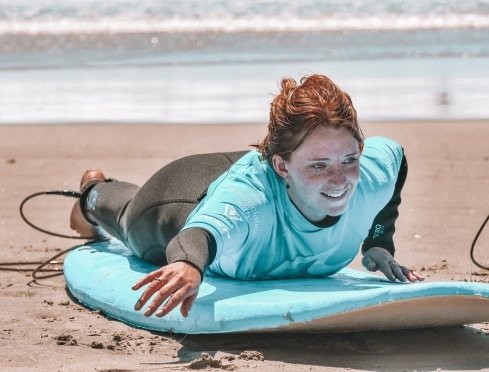
Position on the board first. Find the sweet spot where the nose sits just clear of the water and the tail isn't dragging. This is different for every surfer and every board. Too far forward and you nosedive. Too far back and you're pushing water instead of gliding over it. Arch your back slightly, keep your legs together, chin up.
For the stroke itself, think high elbow. As your hand enters the water, your elbow should stay high, almost like you're reaching over a barrel. This sets up what coaches call an early vertical forearm, which is the position that lets you pull maximum water backwards. Drop the elbow and you're just slapping at the surface.
Pull through to your hip, not your knee. Most beginners exit the stroke way too early. Stay in the pull phase until your hand passes your hip, then recover smoothly with a relaxed arm swing.
At Te Arai and Orewa, where you're often paddling out through rolling sets, good technique means you arrive at the lineup with energy to catch waves, not gasping on the shoulder having burned everything just getting out.